
Your needs, this model
Does it fit your priorities?
What is the documented cookware ceiling for the BiPod GS-370-US?
The exact GS-370 manual lists cookware up to 23 cm (about 9.1 inches) and 4 L, and says not to use Dutch ovens. That is a manufacturer ceiling, not a guarantee that every pan of that size will balance. Check the pan base, load and support contact on a level outdoor surface.
Explore this need in the finder →Which fuel belongs with this exact BiPod package?
The US listing names GigaPower canisters, and the GS-370 manual says to use only its designated Snow Peak cartridges, listing GP-110 and GP-250 series. It does not establish generic EN 417, MSR 80/20 or Jetboil JetPower compatibility. Fuel is separate, so match the canister label to the exact current manual.
Explore this need in the finder →Is the BiPod's listed mass a backpacking minimum, and can I rely on its igniter?
No. The Japanese GS-370 manual lists the stove at 220 g and separately lists the included igniter at 16 g, but it does not label either as a minimum carry weight; count the actual stove package, fuel and cookware yourself. The same manual warns the igniter may struggle in cold or at altitude, so it recommends a separate lighter or matches.
Explore this need in the finder →Assessment scope: This is a source-based review of the current US Snow Peak BiPod Stove, SKU GS-370-US. I did not use, weigh or test it. The support limits, mass and output below come from the manufacturer; they are not independent performance findings.
A wider cooking footprint with a real size ceiling
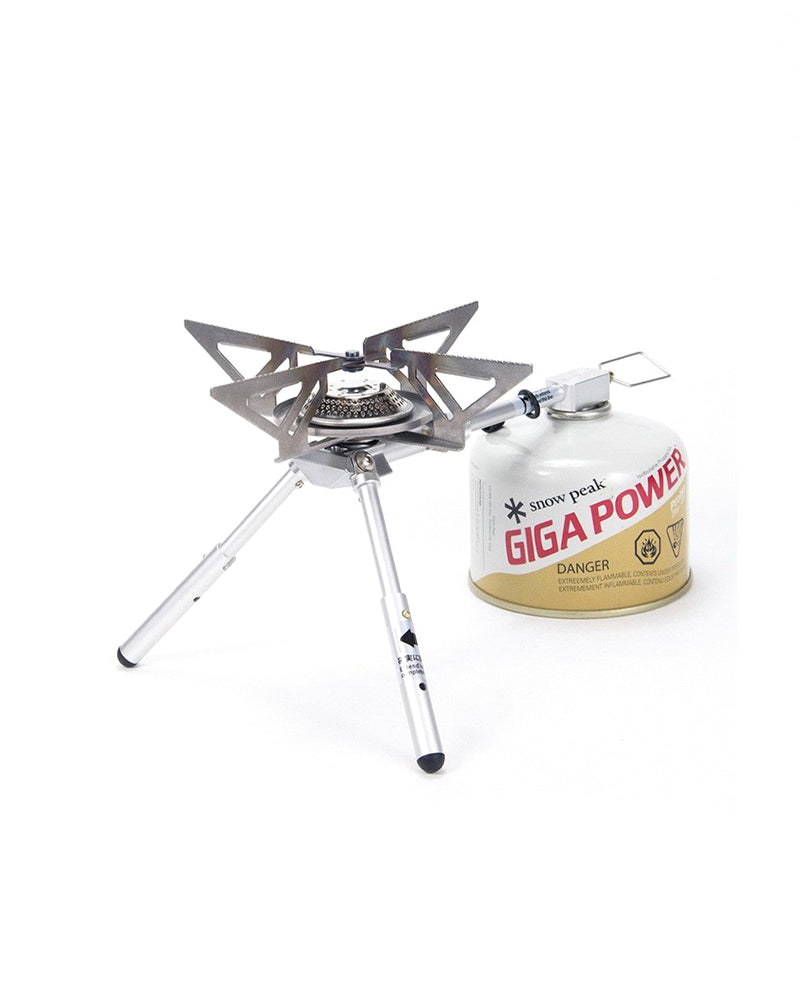
The BiPod is a one-burner canister stove built around wide folding pot supports and two adjustable legs. Snow Peak describes those supports and legs as a stable surface for larger pans. The exact GS-370 manual sets a 23 cm / 4 L cookware ceiling and excludes Dutch ovens. That is larger than the 14 cm / 2 L limit on the two compact GigaPower 2.0 models, but it does not prove every 23 cm pan is stable. Base shape, load, handles and campsite level still matter; check the actual cookware against the arms on stable, level ground.
The broad top does not create multiple cooking positions: one burner cooks one pan at a time. A separate Multi Compact Cookset is mentioned as a possible pairing on Snow Peak's page; that does not make the cookset part of this stove's package. The linked product photograph also shows a GigaPower fuel canister, while the page says fuel is sold separately. Treat the image as a view of the stove in use, not a box-contents list.
Modularity helps setup, but adds pieces to manage
The manual describes a burner unit and a separate valve unit that connect for cooking, then detach for storage. It also shows how the legs adjust for Snow Peak's 110 g and 250 g cartridge sizes. That arrangement is more involved than screwing a compact stove directly onto a canister and unfolding three supports. In return, the legs give the assembly a broad stance and allow the specified canister heights to be accommodated. Buyers should check that the exact cartridge, valve joint, leg position and stove model all follow the manual rather than adapting another brand's canister or connector.
Snow Peak's Japanese GS-370 manual lists a 220 g stove weight and a separate 16 g ignition-unit figure. It does not call either a manufacturer minimum weight or the total mass of a ready-to-cook kit. The fuel canister and cookware are also extra, and the split assembly has storage dimensions for two components. If your decision depends on a hard ultralight threshold, use the complete exact-package contents and do not pass the manual's 220 g entry off as a minimum-weight specification.
Fuel and ignition need more checking than the product name suggests
The US product page tells the buyer to attach the BiPod to a GigaPower canister. The exact model manual is more specific: use only Snow Peak-designated cartridges, including the listed GP-110 and GP-250 series. Neither source establishes a generic EN 417 standard or says this is interchangeable with MSR 80/20 or Jetboil JetPower fuel. Fuel is not included. Confirm the canister's label and the current exact stove manual before purchase, especially if the fuel available on your route is a fixed requirement.
The manual lists an ignition unit and recommends carrying a match or lighter because the igniter can be unreliable in cold or at altitude. That is a useful convenience with a practical backup plan, not a reason to omit an independent fire-starting method. The exact instructions available for GS-370 are in Japanese. Snow Peak's US page links a one-page English precaution sheet, but it is not a complete English setup and specification manual. The article therefore keeps the more detailed limits tied to the exact Japanese model manual and makes the language gap explicit instead of borrowing a different stove's instructions.
Wind protection and cookware shape remain manual checks
The product page and manual do not establish that a separate windscreen is approved for this exact configuration. The linked English precaution sheet warns against an undesignated wind guard, and the Japanese model manual warns against cookware such as griddles, grates, ceramic vessels and smokers that can reflect heat back toward the canister. Do not infer permission from the wide support arms or improvise a foil barrier. The matcher leaves separate-screen permission unknown, so this is not a fit for a trip that requires a manual-approved separate screen.
Snow Peak's manual lists 2,900 kcal/h, a maker figure rather than a boil-time claim or field comparison. The stove is for outdoor cooking only, never a tent, vehicle or enclosed shelter. Check joints for leaks, keep combustibles clear, let the equipment cool and stop if the valve, O-ring or burner is damaged.
Who should compare it with the LiteMax?
The LiteMax Titanium Stove is a different choice: Snow Peak lists 56 g and supports cookware up to 5.5 inches / 2 L, while its exact instructions describe manual lighting. The BiPod's larger 23 cm / 4 L ceiling and wider legs may be more relevant when a larger one-pot menu matters more than compact packing. Its listed stove mass is also much higher, though not a standardized minimum-weight comparison. See the LiteMax assessment for its smaller-pan tradeoff. The current GigaPower Auto and Manual Renewed models are also one-burner canister options, but their exact manuals limit cookware to 14 cm / 2 L.
The BiPod may suit someone who wants one burner, a larger documented cookware envelope and the exact Snow Peak fuel system. It is a poor fit for a minimum-weight cap, two simultaneous pans, a required approved windscreen, a Dutch oven or a trip without the specified cartridges. Before buying, verify SKU GS-370-US, the manual revision, package contents, fuel availability and the actual cookware base.
Key specifications
Key details at a glance
| Burners in one arrangement | 1 |
|---|---|
| Fuel connector | Direct mount canister standard unspecified |
| Specified fuel blend | Snow peak designated cartridge blend unspecified |
| Maximum cookware diameter | 9.06 in |
| Adjustable flame | Yes |
Use the exact model’s instructions for operating limits, supplied equipment and version differences.
Sources for this review
Sources for this assessment
- Snow Peak US Camping Stoves & Burners collection, page 1 of 1
- Snow Peak US collection product feed, first and only observed page
- Snow Peak US BiPod Stove product page, exact SKU GS-370-US
- Snow Peak GS-370 model instruction manual, Japanese, two pages
- Snow Peak US page-linked GS-370 English safety and precaution sheet
- Snow Peak US BiPod Stove exact-page first gallery image
- CPSC recall search and Snow Peak GS-010 recall notice checked against GS-370

Compare this stove against your actual setup
Use the finder for a fact-based shortlist, then confirm the exact manual, fuel cartridge and package before use.