
Your needs, this model
Does it fit your priorities?
Why choose the 2.5 L Reactor system?
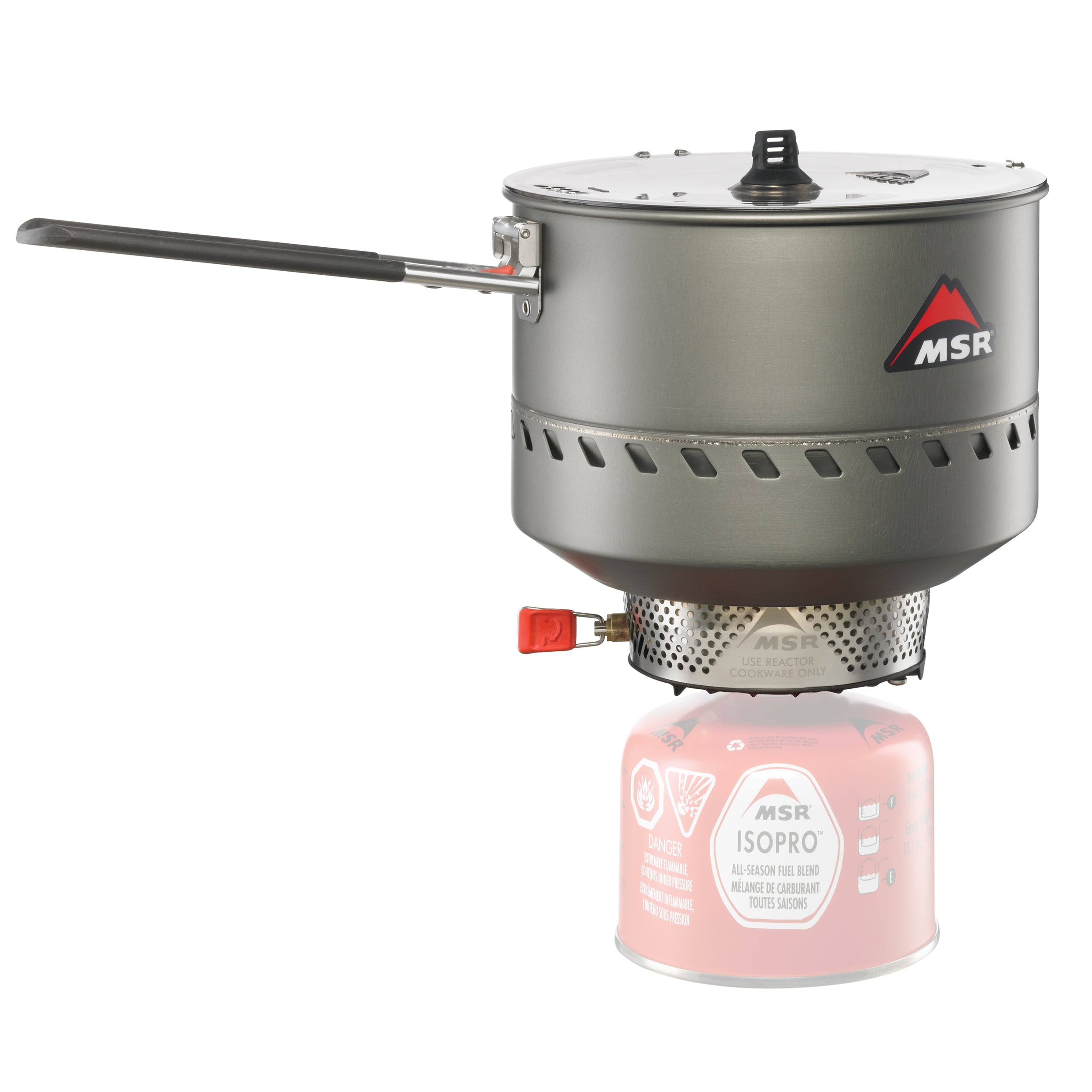
MSR positions this capacity for boiling enough water for five freeze-dried meals at once or expedition snow melting for two to three people. Those are brand use descriptions, not a promise of serving count. It weighs 610 g minimum and 620 g packaged on the product page, more than the listed 1.0 L or 1.7 L systems; the cartridge remains separate.
Explore this need in the finder →Can the 2.5 L pot cook on an ordinary canister burner?
The manual supports Reactor cookware only with the Reactor stove because the pot and radiant burner form a system. It does not publish a general diameter maximum for other pots; a 7.2-inch product width is not permission to use a broad generic pan. Do not put the matched pot on a different burner or use a non-Reactor pot on this burner.
Explore this need in the finder →Does its wide profile make this a stable two-pan or windscreen setup?
No. SKU 06902 remains a single-burner Reactor system. The manual says the compact height can make the stack tip more readily, calls for a stable and even surface, prohibits every kind of separate windscreen, reflector or diffuser, and never permits two stoves to operate together. A wider pot does not create a second cooking position.
Explore this need in the finder →MSR's current Reactor Stove Systems listing pairs a single canister burner with three different Reactor pots. This review is specifically for the 2.5 L US configuration, SKU 06902 / UPC 040818069028. It is not the 1.0 L or 1.7 L stove dressed with a larger accessory pot: the current listing assigns separate variant identities and publishes distinct dimensions, weights and capacity guidance for each system.
Why this pot is the group-oriented choice
The package includes the Reactor stove, a 2.5 L Reactor pot, BPA-free strainer lid, PackTowl pot protector and folding, locking handle. MSR sells the canister separately. The brand describes this size as sufficient to boil water for five freeze-dried meals at once or as an expedition snow-melting option for two to three people. Those examples communicate the intended batch size, not a guarantee about portions, menu, snow volume or time on a particular trip.
The larger vessel is the most conspicuous distinction. The manufacturer lists 7.2 by 7.7 by 5.8 inches, a 610 g minimum system weight and 620 g packaged weight; it does not separately report a bare-burner mass here. The variant JSON has a separate 607 g field with no indication whether it is minimum or package weight. Other size rows also show small discrepancies between the page's imperial and rounded metric figures, so the finder uses the named 0.61 kg system minimum, not the unlabeled raw field. The 1.7 L system is listed at 490 g minimum; the 1.0 L at 420 g. Compare it with burner-only weights only after accounting for the matched-pot system the listing actually describes.
One cooking position; exact cookware only
The current manual covers all three Reactor sizes and describes one burner in a pot-and-burner arrangement. It says never to operate two stoves together, and the wider 2.5 L pot does not add a second cooking position. This is a batch-boil setup rather than a simultaneous two-pan kitchen. If your meal depends on a pan beside a pot, choose a model whose manual actually supports that cookware and burner layout.
Reactor cookware is the only cookware MSR's manual permits on this stove. The product dimensions are not a generic skillet limit; the available sources do not publish a maximum diameter for arbitrary pots. The instructions specifically mark a maximum fill line on the 1.0 L and 1.7 L pots, but do not give that same fill-line direction for the 2.5 L pot. Nominal 2.5 L capacity should not be treated as a guaranteed amount of usable cooking volume. Use the exact vessel and current manual rather than inferring its safe fill from the marketing capacity.
This size nests around an 8 oz MSR canister in the product image, but that cartridge is not included. The manual specifies MSR 80% isobutane / 20% propane EN 417 fuel and gives canister size and stability directions. MSR's FAQ confirms the threaded, self-sealing connection for Reactor canister stoves. Check the canister's exact dimensions and label; do not substitute a different fuel system because its connector looks similar. For a smaller package, compare the 1.0 L and 1.7 L configurations.
Wind claims do not erase manual limits
MSR publishes a three-minute-per-liter boil time for the 2.5 L system and about 22 liters boiled per 227 g IsoPro cartridge. The product page also describes wind protection and fuel efficiency. These figures and design descriptions are manufacturer claims, not a field test or a promise in a particular weather. The instructions nevertheless prohibit every kind of accessory windscreen, reflector or diffuser. Do not wrap a shield around the canister or assume the burner enclosure changes that rule.
MSR warns that the Reactor's compact height can make the pot-and-canister system tip more easily, so it directs users to a solid, even, stable surface. The stove must be used outdoors, kept attended, not used with dry or empty cookware and allowed to cool for at least five minutes before movement. The manual sets 0°F (-18°C) as the minimum operating/storage temperature and describes an internal thermal trip that shuts the stove down if it overheats. If that happens, stop using the stove and follow MSR service guidance; it is not a user reset or a sign to try improvised cookware.
Exact code and offer checks
The 2024 recall notice identifies earlier Reactor 1.0 L and 1.7 L stove systems and selected 1.0 L and 1.7 L pots; the current 2.5 L system code 06902 is not one of those named SKUs. That is a narrow match against that recall table, not a guarantee about any used cookware, mixed parts or subsequent notice. Verify the exact stove and pot on the offer. Also confirm the matched 2.5 L Reactor vessel, lid, protector, handle and separate fuel requirements; never use a product photograph alone to infer package contents.
Key specifications
Key details at a glance
| Manufacturer-listed minimum weight | 610 g |
|---|---|
| Packaged weight | 620 g |
| Burners in one arrangement | 1 |
| Fuel connector | Threaded EN 417 canister connection |
| Specified fuel blend | MSR 80% isobutane / 20% propane |
| Included pot capacity | 2.5 L |
| Fuel canister included | No |
| Adjustable flame | Yes |
| Separate windscreen permitted | No |
| Manual's minimum operating temperature | 0 °F |
Use the exact model’s instructions for operating limits, supplied equipment and version differences.
Sources for this review
Sources for this assessment
- MSR Reactor Stove Systems — official US product page
- Official MSR storefront variant data for Reactor Stove Systems
- MSR Reactor Stove Systems — current English instruction manual #34-434
- MSR FAQ: fuel connection and canister stove guidance
- Cascade Designs / MSR current pot-handle recall notice
- CPSC Recall 24-126: select Cascade Designs camping cooking pots
Compare this stove against your actual setup
Use the finder for a fact-based shortlist, then confirm the exact manual, fuel cartridge and package before use.