
Your needs, this model
Does it fit your priorities?
What does the 1.0 L capacity tell me about the Reactor system?
The current US listing is the matched Reactor stove-and-1.0 L pot configuration, SKU 14268. MSR describes it for one or two people or trips where space and weight matter, but that description is a use-case guide, not a guaranteed serving count. The manual marks a maximum fill line on the 1.0 L pot: follow it rather than assuming the full nominal volume is a safe working fill.
Explore this need in the finder →Can I use a different camping pot or add a windscreen to SKU 14268?
No. The Reactor manual requires Reactor cookware and prohibits every kind of windscreen, reflector and diffuser. MSR's 1.0 L Reactor Cookware is the corresponding pot size; it is not a generic diameter-based fit. Set the matched system on a stable, level surface and obey its canister support rules.
Explore this need in the finder →Does the 1.0 L Reactor package include fuel, and how heavy is it?
MSR lists 420 g (0.42 kg) minimum and 430 g (0.43 kg) packaged weights for the system, but says the fuel cartridge is sold separately. Its product feed's raw 422 g field is not identified as minimum or packaged weight. Add the exact cartridge and any personal trip items to your carry plan; do not use the product-photo canister as package proof.
Explore this need in the finder →The current US Reactor listing presents three pot sizes around one integrated canister stove: 1.0 L SKU 14268, 1.7 L SKU 14269 and 2.5 L SKU 06902. They share the same radiant-burner family, but their pot capacity, dimensions, published weights and manufacturer use descriptions differ enough that this is a separate configuration assessment rather than a capacity footnote. The 1.0 L option is the smallest complete Reactor system, not a 73 g bare burner.
What the 1.0 L system actually packages
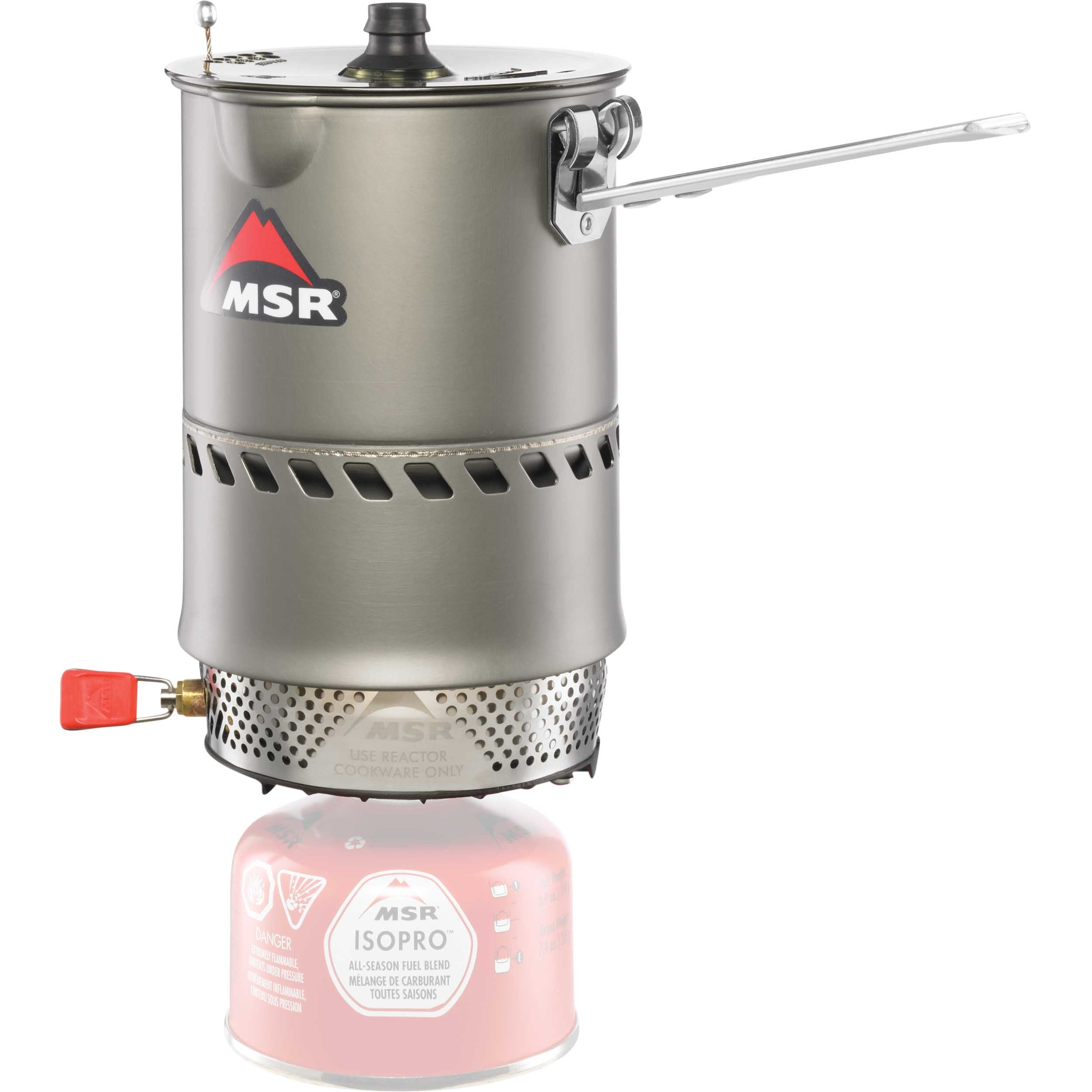
MSR lists a Reactor burner with its matched 1.0 L pot, BPA-free strainer lid, PackTowl pot protector and a folding, locking handle. The canister in the official photograph is sold separately. The maker describes this size for trips with one or two people, or when space and weight are at a premium. That is useful intent-setting, not a serving guarantee: the pot's marked fill limit, menu, snow volume and number of cooking rounds still matter.
The exact 1.0 L version is smaller and lighter than the other two Reactor sizes, with manufacturer-listed dimensions of 4.8 by 5 by 6.3 inches. MSR gives this matched-pot system a 420 g metric minimum and 430 g packaged weight; neither number is a separately stated bare-burner mass. The linked variant JSON carries 422 g without saying whether that figure is minimum or packaged, while the page's imperial and rounded metric weights do not convert identically. The finder keeps the manufacturer's named metric minimum as a conservative system-weight value and the ambiguity visible, not as a measurement of the burner alone.
One matched vessel, one cooking position
The Reactor is an integrated stove-and-pot arrangement. The manual says to use Reactor cookware only because this burner and vessel are designed to work together. It does not establish a generic maximum pan diameter for the 1.0 L model, so a pot's measured width or a similar-looking heat-exchanger vessel is not a compatibility pass. The nominal one-liter capacity is also not permission to fill the pot to the rim; the instructions explicitly say to stay below the fill line on the 1.0 L and 1.7 L pots.
This is a single cooking position. It can support a one-pot boil-and-eat sequence, but it cannot heat a second pan at the same time. MSR's marketing says the 1.0 L pot nests with its smaller 4 oz canister; the manual and product listing still make clear that fuel is separate. A nested cartridge is a packing possibility, not evidence that one cartridge covers every trip's meal plan. If the larger group-oriented vessel matters more than the compact size, compare the 1.7 L Reactor and 2.5 L Reactor assessments. None becomes a multi-burner stove by carrying a larger pot.
Fuel, setup and limits that matter
The current English #34-434 instructions specify an MSR cartridge with an 80% isobutane / 20% propane blend certified to EN 417; MSR's FAQ says its Reactor canister stove uses a threaded, self-sealing cartridge. The manual limits canister size and gives separate support directions for small-diameter or taller containers. Check the exact canister's weight and dimensions against that text before packing it. Do not treat an adapter, another blend or a generic propane cylinder as an approved substitute.
The manual prohibits any kind of separate windscreen, reflector or diffuser. Its radiant enclosure is not a permission to wrap foil around the burner. Reactor cookware is the only supported vessel; the system must sit on a firm, even, stable surface because the compact, elevated arrangement can tip. The instructions require outdoor use only, prohibit running two stoves together, warn against operating the system empty or dry and say to cool it for five minutes before moving it. It lists a 0°F (-18°C) lower operating/storage limit and describes an internal thermal trip that shuts the stove off if it overheats. That trip is a safety mechanism, not a field repair feature.
Published performance is a reference, not a trial
MSR publishes a 3.5-minute-per-liter boil time for this size, around 80 minutes of burn time per 227 g IsoPro cartridge and about 20 liters boiled per cartridge. These are manufacturer figures, not results independently reproduced here. Wind, starting temperature, water volume, pot fill and technique can change real trip outcomes. The small system is worth considering when the matched pot and quick boil-water routine align with the trip; it is not a broad-pan solution, a two-pot kitchen or a promise of exceptional simmer finesse.
Recall-era identity and buying checks
Recall 24-126 identifies an earlier Reactor 1.0 L Stove System, SKU 06898, and a separate older 1.0 L pot, SKU 06900. The current US product feed identifies this configuration as SKU 14268 / UPC 040818142684, which is not one of the recall table's named system SKUs. That is a bounded comparison with one notice, not a blanket statement about used cookware, mixed-generation kits or future notices. Confirm the exact stove and pot codes on any offer and follow current MSR recall instructions if an older item is present.
Before choosing the 1.0 L, check the exact package, fuel label, pot identity and manual. Add fuel to the published system mass, leave the fill line headroom and use the matched vessel on a level outdoor surface. If your task needs a generic skillet, a documented diameter ceiling or two simultaneous burners, the current evidence does not establish this Reactor configuration as that answer.
Key specifications
Key details at a glance
| Manufacturer-listed minimum weight | 420 g |
|---|---|
| Packaged weight | 430 g |
| Burners in one arrangement | 1 |
| Fuel connector | Threaded EN 417 canister connection |
| Specified fuel blend | MSR 80% isobutane / 20% propane |
| Included pot capacity | 1 L |
| Fuel canister included | No |
| Adjustable flame | Yes |
| Separate windscreen permitted | No |
| Manual's minimum operating temperature | 0 °F |
Use the exact model’s instructions for operating limits, supplied equipment and version differences.
Sources for this review
Sources for this assessment
- MSR Reactor Stove Systems — official US product page
- Official MSR storefront variant data for Reactor Stove Systems
- MSR Reactor Stove Systems — current English instruction manual #34-434
- MSR FAQ: fuel connection and canister stove guidance
- Cascade Designs / MSR current pot-handle recall notice
- CPSC Recall 24-126: select Cascade Designs camping cooking pots
Compare this stove against your actual setup
Use the finder for a fact-based shortlist, then confirm the exact manual, fuel cartridge and package before use.