
Your needs, this model
Does it fit your priorities?
Can the Profile cook two separate pots at once?
The exact P329086 US page identifies two burners with separate controls, so two cooking positions are documented. It is not a serving estimate; check the actual pot footprints and table space because Primus supplies no maximum cookware diameter here.
Explore this need in the finder →Which fuel setup is specified, and is fuel in the box?
The exact US page says the stove uses a refillable propane cylinder through an included hose and regulator with M14x1.5 connections; gas is not included. Confirm the cylinder outlet, supplied regulator and exact P329086 instructions. The regional Atle 3290 manual is not treated as proof that this US listing accepts Primus canisters, MSR 80/20 or Jetboil JetPower.
Explore this need in the finder →Does the page establish a carry weight, pot limit or extra-screen permission?
Primus lists 5200 g in the product table, but the variant record says 2268 g, so the discrepancy and basis remain unresolved and neither value is a manufacturer minimum-weight match. The page does not set a maximum pot diameter. Its lid and side windshields are built in; no exact US manual was located to authorize an extra separate screen.
Explore this need in the finder →Scope: This source-based assessment covers the US Primus Profile Camping Stove, article P329086 / UPC 7330033914771. I did not own, unfold, connect, ignite, weigh or cook on it; output and boil statements below are manufacturer claims, not tests. Primus's US product page and variant record identify this exact configuration. The page says the Profile is named Atle in Europe, but the related Atle booklet does not explicitly crosswalk its instructions to US P329086.
A two-pan camp stove for table or vehicle access
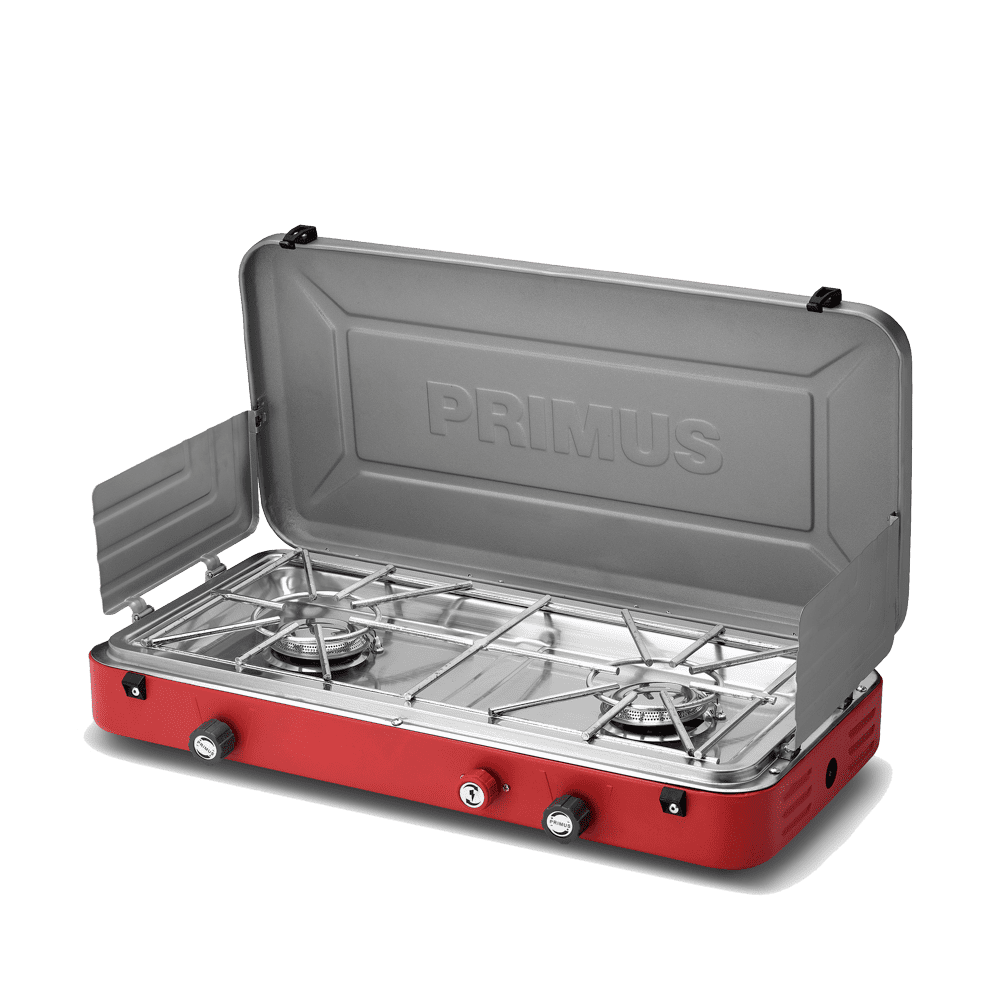
The Profile is a folding rectangular stove with two burner heads, each described as having its own control knob and built-in piezo igniter. That layout is more relevant than a single burner when a meal calls for a pot to boil while a second vessel stays at a different heat setting. The independent knobs are manufacturer-described flame controls; they do not establish that every pan can hold a delicate simmer or that the burners were tested side by side. Count the physical cooking positions, not servings.
Primus describes the cooking area as broad enough for heavy pots and a frying pan, but gives no maximum cookware diameter in the US product table. Two pots still need to clear each other, their handles and the raised wind panels. A claimed ability to hold heavy pots is not a numeric cookware limit or a guarantee for an unusual pan base. Measure the actual pots against the full support layout and use a stable, level outdoor table with room for the stove body and its open lid.
Fuel is a propane-cylinder system, not a backpacking canister match
The exact US page says the Profile connects to a refillable propane cylinder with M14x1.5 connections using the additional hose and regulator included with the stove. It also states that gas is not included. This supports a propane-cylinder arrangement, but not a universal claim about every tank, disposable cartridge or hose sold as “propane.” Check that the actual cylinder outlet, supplied regulator and model label match the exact P329086 instructions. Keep the connection outdoors, inspect seals and follow the booklet's leak-checking process before operation.
The related paperwork needs extra care. The US manuals index lists an Atle Stove booklet, and the Profile product page says the European-market name is Atle. That booklet identifies model 3290 and names Primus cylinders 2006/2012, while the US P329086 product page describes a refillable propane cylinder on the supplied hose/regulator. The captured sources do not establish that the 3290 instructions cover this US article or resolve the hardware difference. Do not use the regional manual to assume a different cylinder fits; obtain the current manual and warning label supplied for the US unit. Until then, exact clearances and other instructions for P329086 remain unknown.
Integrated wind protection is not permission for another screen
The folding lid and side panels act as built-in windshields; Primus says the side shields can extend in windy conditions. They are part of the stove's designed cooking layout. The product page does not say that a separate external shield, foil wrap or improvised wall may be added, and the exact US manual was not located to authorize one. So the Profile does not pass a hard request for manual-approved separate-screen use in this assessment. Keep combustible materials away and wait for all hot panels and supports to cool before folding or transport; use the exact model instructions for required clearances and any wind guidance.
The page claims that a liter of water can boil in three minutes, but that is Primus's figure, not a timed result from this review. Its narrative describes a 14,000 BTU / 4100 W flame without making clear whether that is a per-burner or combined number. The technical table instead lists 3360 W and 240 g/h. These maker statements are not reconciled here, so they should not be used as proof of independently verified speed, fuel economy or heat balance between burners.
Carry and cookware numbers need a manual check
Primus's technical table gives the Profile as 590 mm wide, 320 mm deep and 100 mm high, with a 5200 g weight. The linked variant record separately reports a weight of 2268 g. The sources do not explain the discrepancy or its basis, so this review does not choose a favorite value or label either as minimum stove weight. The questionnaire's numeric minimum-weight field therefore remains unknown. The listed dimensions are useful for planning table and vehicle space, but they do not describe a packed-bag footprint or a cookware diameter.
For a closer Primus comparison, the Kinjia P350142 and Tupike P350151 are also two-burner camp stoves. Their product pages document different case and burner arrangements; the Tupike page, for instance, calls out folding legs and a griddle, while the Profile page emphasizes the propane-cylinder hose and integrated windshields. The larger Alika P350163 also has two burners but uses its own Primus-cartridge family and optional adapter documentation, so it is not a substitute fuel connection. For another two-burner outdoor layout, compare the Coleman Cascade 222 review and its exact package/manual limits; similarity of footprint does not make the fuel systems interchangeable.
Who should compare the US P329086
The Profile is worth comparing if the actual job is two simultaneous cooking positions at a campsite with a compatible refillable propane cylinder, and if an enclosed, fold-flat body with integrated side shields suits the available table space. It is a poor shortcut for a compact trail burner, a specified MSR or Jetboil cartridge plan, a verified lightweight pack, or a setup that needs an extra separately approved windscreen. Before considering an offer, check P329086 on the unit and box; confirm the exact cylinder outlet, included hose and regulator; get the matching US manual and label; verify the intended pot footprints; and ask the seller to resolve which weight applies to the actual unit. No price, stock status or product performance is promised by this assessment.
Key specifications
Key details at a glance
| Burners in one arrangement | 2 |
|---|---|
| Fuel connector | Refillable propane m14x1 5 hose regulator |
| Specified fuel blend | Propane |
| Push-start ignition | Yes |
| Adjustable flame | Yes |
Use the exact model’s instructions for operating limits, supplied equipment and version differences.
Sources for this review
Sources for this assessment
Compare this stove against your actual setup
Use the finder for a fact-based shortlist, then confirm the exact manual, fuel cartridge and package before use.