
Your needs, this model
Does it fit your priorities?
What fuel and canister setup does the current 1.8 L Duo use?
The linked English manual requires an 80% isobutane / 20% propane cartridge certified to EN 417. MSR recommends IsoPro; its support FAQ says a different brand may be suitable only when it uses that blend and certification, but the company makes no quality or performance guarantee. The 8 oz cartridge shown as nestable is sold separately, and the manual prohibits containers larger than 16 oz / 450 g. The Duo is remote-fed but not intended for inverted-canister liquid-feed operation.
Explore this need in the finder →Does the Duo accept a generic 8-inch frying pan?
No. The Duo manual says to use WindBurner cookware only, and MSR's compatibility material lists the designed WindBurner family for the remote-canister stove, including its Duo 1.8 L pot, Personal 1.0 L pot, skillet, 2.5 L Sauce Pot and 4.5 L Stock Pot. The sources do not give a generic maximum diameter for this cookware, so an 8-inch numeric requirement is not verified by the pot's size or capacity.
Explore this need in the finder →Does its larger pot provide two cooking positions or a lightweight burner-only load?
No. The current SKU 14049 is a single remote-canister burner with one supported cooking position; MSR's 1.8 L and two-person description does not mean two pans can heat at once. The manufacturer lists 597 g minimum and 605 g packaged weight for the integrated product, fuel sold separately, and the variant feed's separate 598 g value has no stated weight basis.
Explore this need in the finder →This assessment covers the current U.S. MSR WindBurner Duo Stove System, 1.8 L, SKU 14049 / UPC 040818140499. It is the remote-canister Duo configuration, not the earlier 1.8 L WindBurner generation with a burner mounted directly on the fuel cartridge. The distinction changes stability and which WindBurner vessels the stove supports. The manufacturer listing currently identifies the exact configuration, but this review uses no claim about current stock or price.
A matched cooking system, not a bare burner
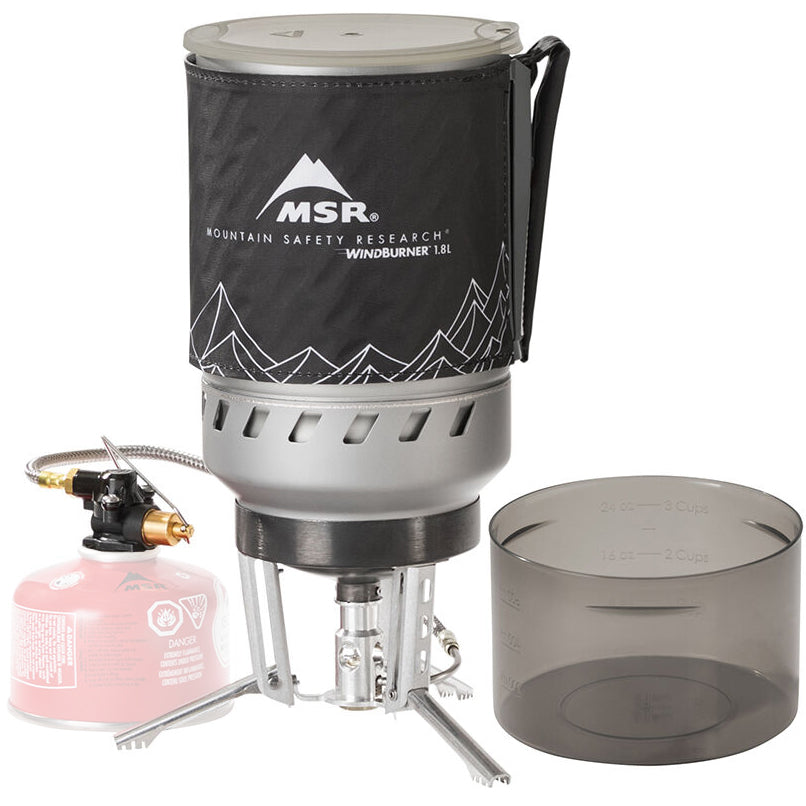
MSR's written product-page contents name a radiant burner with boil-to-simmer control, pressure regulator, 1.8 L hard-anodized pot with an integrated heat exchanger and insulated cozy/handle, drinking-and-straining lid, and 0.85 L integrated bowl. The page says an 8 oz MSR IsoPro canister fits in the pot but is sold separately. Those are useful parts for a compact two-place meal routine, yet they are not two burners and not generic cookware. Fuel, food and water are not included in the listed system weights.
The page lists 597 g minimum weight, 605 g packaged weight and packed dimensions of 5 by 5 by 8 inches (12.5 by 12.5 by 20.5 cm). Neither figure is a separately stated burner-only mass. The storefront variant feed reports 598 g without identifying whether that is minimum or packaged weight, so it is kept distinct rather than substituted. An older or seller-assembled offer may also include parts not repeated in the current written contents list: the manual's Duo diagram and packing steps name a PackTowl and base cup, while the current product page does not list them. Check the exact package before treating every pictured or manual-diagram component as included.
What changes with the remote-canister layout
The burner sits on deployed legs and connects by hose to a canister beside it, rather than balancing the whole vessel above a cartridge. MSR's current compatibility FAQ identifies this remote design with its larger WindBurner systems and says it supports the Personal 1.0 L pot, Duo 1.8 L pot, skillet, 2.5 L Group Sauce Pot and 4.5 L Stock Pot. By contrast, the top-mounted 1.0 L Personal stove and an earlier top-mounted 1.8 L system are limited to the Personal and Duo pots and skillet; the larger vessels are less stable on that design. This is a real system-generation difference, not permission to place an ordinary pot on the Duo burner. MSR's instructions require WindBurner cookware only, and the exact cookware family is not assigned a generic maximum diameter in the reviewed sources.
MSR describes the 1.8 L pot as suited to two people, but capacity does not guarantee portions or replace a second cooking position. The 0.85 L bowl is an included serving/eating vessel, not another burner. A 1.0 L Personal system weighs less in MSR's product-page minimum-weight figures, while the Duo adds pot capacity and a remote base intended to support the larger compatible WindBurner pots. If a trip genuinely needs simultaneous pans, compare it with a multi-burner camp stove rather than reading “Duo” as a burner count.
Wind-oriented design still has strict limits
MSR markets the enclosed radiant burner and regulator for windy and colder conditions. The product page gives approximate IsoPro figures of 4.5 minutes to boil one liter, about 95 minutes of burn time per 227 g canister, and 18 liters boiled per canister. These are manufacturer planning figures, not results from a test by this author, and they do not promise a particular boil time in a specific gust, temperature, altitude or meal routine. The instructions explicitly prohibit any windscreen, reflector or diffuser; a shroud and wind-resistant claim do not authorize an improvised shield.
The manual requires an 80% isobutane / 20% propane cartridge certified to EN 417, says not to use containers larger than 16 oz (450 g), and tells users to check the seals and connection for leaks. MSR recommends its IsoPro fuel. Its support guidance says another brand may be suitable only if the blend and certification match, without guaranteeing that fuel's quality or stove performance. The remote design is not a liquid-feed arrangement: Cascade Designs says the Duo, Group and Combo should not be operated with the canister inverted. The manual also warns that O-rings can stiffen and leak below freezing, so a pressure regulator is no substitute for the exact operating instructions or a leak check.
Setup, service and recall checks
Set the deployed stove on a solid, level, stable surface, use the included matched pot or another WindBurner vessel confirmed by MSR, and never leave a burning or hot system unattended. The manual prohibits operating the stove with an empty or dry pot, says to stay below the pot's MAX FILL mark, and requires at least five minutes of cooling before moving the hot assembly. It is an outdoor appliance only. If the burner is damaged, leaks, or becomes inoperable, stop using it; MSR says stove service belongs with an authorized service provider, not an improvised field repair.
The current MSR and U.S. CPSC notice 24-126 lists selected Reactor and Trail Lite cookware, PocketRocket/Trail Lite kits and other named pot packages. It does not name current WindBurner Duo SKU 14049. That is a bounded check of one published notice, not proof that every earlier WindBurner pot, replacement part or future offer is free of a safety issue. Used gear and mixed packages deserve a code-level check of the actual pot and system.
The Duo makes sense when its remote layout, specific 1.8 L pot and WindBurner-only cookware family match the trip. It is a heavier, dedicated system rather than a small standalone stove, and it remains one burner with no approved separate windscreen. Confirm SKU 14049, the exact included pieces, the fuel label and the complete current manual before buying or lighting it.
Key specifications
Key details at a glance
| Manufacturer-listed minimum weight | 597 g |
|---|---|
| Packaged weight | 605 g |
| Burners in one arrangement | 1 |
| Fuel connector | Threaded EN 417 canister connection |
| Specified fuel blend | MSR 80% isobutane / 20% propane |
| Fuel canister included | No |
| Pressure regulator | Yes |
| Adjustable flame | Yes |
| Separate windscreen permitted | No |
Use the exact model’s instructions for operating limits, supplied equipment and version differences.
Sources for this review
Sources for this assessment
- MSR WindBurner Duo Stove System — official current US product page
- Official MSR US storefront variant data for WindBurner Duo
- MSR WindBurner Duo and Group Stove Systems — English instruction manual #33-944-3
- Cascade Designs: Which WindBurner Pots can I use with which stoves?
- Cascade Designs: Can I use any pot on a WindBurner stove?
- Cascade Designs: Can I use another brand of canister fuel with MSR stoves?
- Cascade Designs: Can the WindBurner Duo, Group or Combo stove use inverted-canister liquid-feed mode?
- Cascade Designs / MSR current pot-handle recall notice 24-126
- U.S. CPSC Recall 24-126: Cascade Designs camping cooking pots
Compare this stove against your actual setup
Use the finder for a fact-based shortlist, then confirm the exact manual, fuel cartridge and package before use.