
Your needs, this model
Does it fit your priorities?
Does this Coleman model use the finder’s MSR 80/20 threaded canister fuel?
No. Coleman names its C250 220 g cartridge, and the 3001 Series manual says Coleman disposable butane/propane mix cylinders only. The sources do not establish an 80/20 blend or EN 417 certification, so do not substitute an MSR cartridge or assume compatibility.
Explore this need in the finder →Is the 3.25-minute one-liter figure a field-test result?
No. Coleman publishes that figure as a product claim; it is not our timed test. The same page lists 10,000 BTU in the narrative but 26,000 in a specification field, while the 3001 Series manual says 10,000 BTU/H.
Explore this need in the finder →May I add a separate windscreen around the cartridge?
The reviewed 3001 Series manual does not document an approved separate windscreen. Its product page lists a wind block, but that does not authorize an added shield. Follow any current model instructions and never enclose or overheat a fuel cartridge.
Explore this need in the finder →This is a source-based assessment of Coleman’s current US listing for model 3001, SKU 2000038017. We have not operated the stove, timed a boil, tested flame control or weighed it. Two important listing details conflict, so this review does not treat its weight, ignition or pressure-control figures as settled.
A small top-mounted stove with a narrow fuel brief
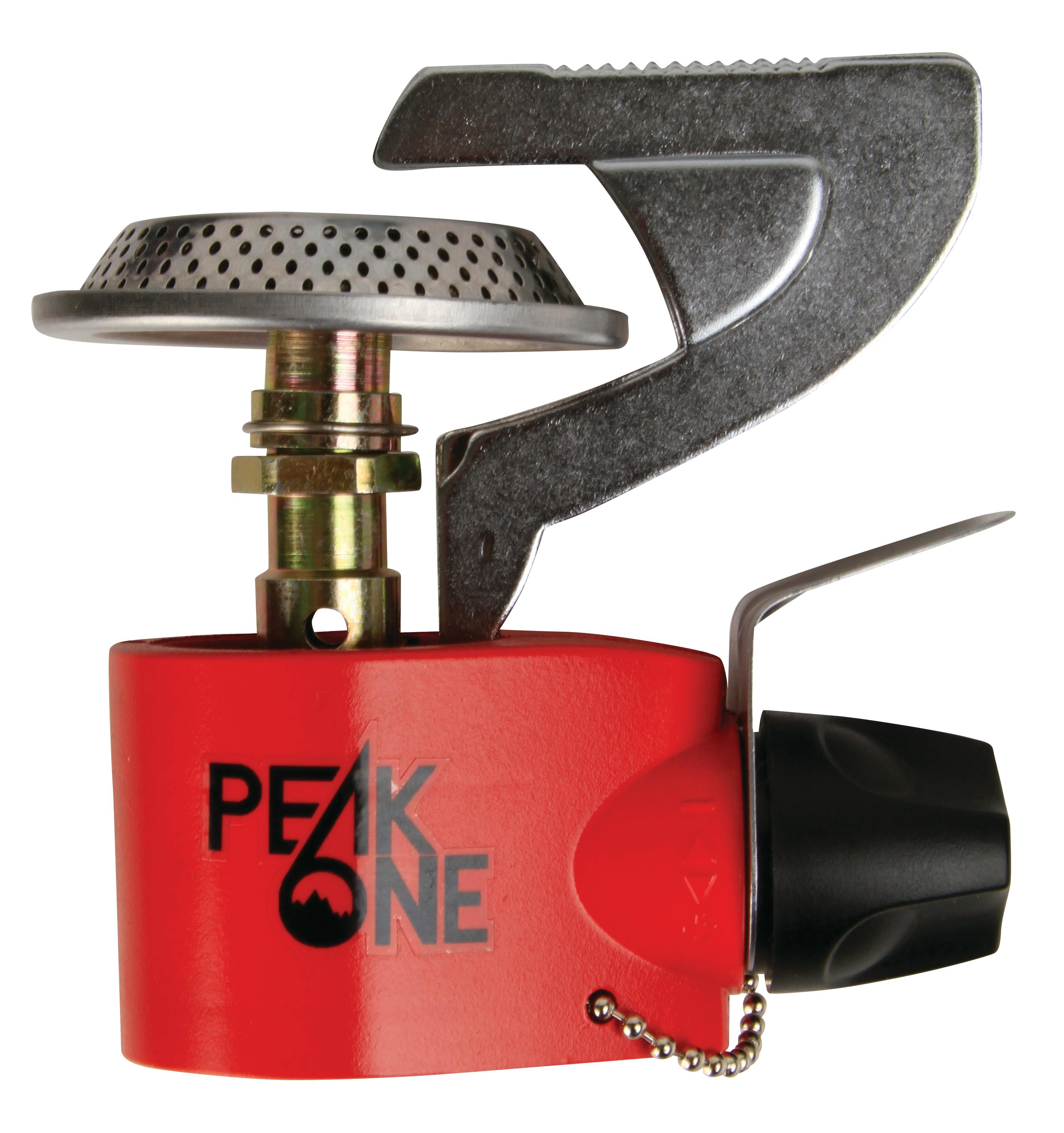
The Single Burner Backpacking Butane/Propane Stove is a folding, one-position burner that sits directly on its fuel cartridge. Coleman’s current page names model 3001 and SKU 2000038017, lists a red finish, serrated pan supports, a three-year limited warranty, and one burner. This is a different system from the company’s refillable liquid-fuel Guide Series 533 and from the broader tabletop Powerpack: the 3001’s small disposable cartridge attaches at the burner rather than feeding a remote hose or an integrated pump tank.
The exact fuel boundary matters more than the generic “butane/propane” label. Coleman’s current product copy specifies its C250 220-gram cartridge and says one cartridge can last up to an hour on high. The official 3001 Series instructions say to use only a Coleman 7¾-ounce disposable butane/propane mix cylinder and expressly warn against connecting bulk LPG. Those sources do not establish an 80/20 ratio or an EN 417 certification for the cartridge, so this assessment does not treat it as the MSR 80/20 threaded-fuel choice in our finder. Check the current manual and the exact cartridge label; do not substitute a different canister, adapter or bulk tank because the connector appears to fit.
Documented heat features—and a spec conflict
The official product description says the burner can boil one liter of water in 3.25 minutes, has up to 10,000 BTU of cooking power, and adjusts from simmer to full boil. Those are manufacturer claims, not results from our test. The same page’s specification block instead lists 26,000 BTU and an “Instant Start” flag, while its ignition-type entry says match flame. The model 3001 manual supports match lighting and lists a 10,000 BTU/H input under “Unregulated LPG.” I rely on the manual and the detailed narrative for the documented use, but preserve the webpage’s contradictory specification instead of silently repeating it as settled fact.
There is a similar disagreement about carrying mass: the narrative says 6.7 ounces / 189.9 grams, while the specification block lists 0.550 pounds, about 249.5 grams. Neither is explicitly labeled “minimum weight,” and the two values do not agree. The finder therefore does not use a normalized minimum-weight figure for this SKU. Do not use either number as a verified pack-ready mass; confirm the exact unit and what the seller’s package includes.
Pan support and wind are not unlimited
Coleman says the stove is designed to fit a six-inch pan, with folding supports and serrations intended to resist cookware slipping while stirring. That is useful configuration evidence, but the listing does not call six inches the maximum cookware diameter, and the current linked 3001 manual does not state a numeric maximum. We leave the maximum unknown rather than turning one example pan size into a safety ceiling or promising that a wider vessel will be stable.
The specification block marks “Stove Wind Block: Yes,” but that does not establish permission to add a separate windscreen. The 3001 instructions do not document an approved separate screen. The finder’s windscreen result consequently excludes this model unless exact current instructions provide permission; never wrap a shield around the fuel cartridge or infer approval from an integral baffle. The manual requires outdoor use only, a sturdy flat surface, and at least 24 inches of side clearance and 48 inches overhead from combustible materials. It also requires checking the connection for leaks with soapy water rather than a flame, and attaching or removing the fuel source outdoors only when the stove is cool and unlit. Read the complete instructions before use.
Where this listing fits—and where it does not
This is a plausible short-list candidate for a cook who wants one compact burner, can reliably obtain the exact Coleman disposable cartridge, and expects to use small cookware. Coleman documents a boil-water use and a simmer-to-boil adjustment range, so the researched arrangement matches those two finder choices and “one burner is enough.” It does not match the exact MSR fuel option, a two-burner requirement, or a request for a manufacturer-confirmed weight cap, cookware maximum or separate-windscreen permission.
Compared with MSR’s PocketRocket 2, the Coleman’s product page names a specific C250 cartridge instead of the MSR manual’s 80/20 EN 417 blend; their fuel choices are not interchangeable. Compared with Coleman’s Guide Series 533, model 3001 avoids a refillable tank and pump, but its published weight claims conflict and its cartridge boundary is narrower. These are setup differences, not a claim that one stove boils faster in a real campsite. Coleman’s own 3.25-minute figure is not a controlled comparison against either model.
Checks before buying or using one
Verify model 3001 and SKU 2000038017 rather than relying on a similar red PEAK1 photo or a seller’s short title. Confirm the exact cartridge the current instructions name, whether it is sold separately, and whether the package contains only the burner. Coleman lists the burner as the included item and fuel separately. Confirm which weight claim applies to the exact unit, but do not treat that as minimum weight until the manufacturer resolves the discrepancy. Finally, read the full current manual for lighting, leak checking, clearances and any later revision. This review is a researched comparison aid, not a substitute for the manufacturer’s safety instructions or a report of hands-on performance.
Sources: Coleman’s current US product page for SKU 2000038017 and the official 3001 Series instructions.
Key specifications
Key details at a glance
| Burners in one arrangement | 1 |
|---|---|
| Fuel connector | Coleman C250 / 7¾ oz disposable cartridge; connector standard not established |
| Specified fuel blend | Coleman butane/propane mix; ratio not published |
| Fuel canister included | No |
| Adjustable flame | Yes |
Use the exact model’s instructions for operating limits, supplied equipment and version differences.
Sources for this review
Sources for this assessment
- Coleman Single Burner Backpacking Butane/Propane Stove, current US listing for model 3001 / SKU 2000038017
- Coleman official Peak 1 / 3001 Series outdoor-stove instructions
- Coleman current US camping-stoves parent category, visible segment only
- Coleman current single-burner category, showing 7 of 7 cards
Compare this stove against your actual setup
Use the finder for a fact-based shortlist, then confirm the exact manual, fuel cartridge and package before use.