
Your needs, this model
Does it fit your priorities?
Does the CS14 count as one burner?
It has one wood-burning firebox under a continuous cooktop, but Camp Chef does not publish gas burner or simultaneous burner counts. The finder cannot confirm even the one-burner requirement from that firebox; see the wall-tent setup limits before treating it as a camping kitchen.
Explore this need in the finder →Will a 12-inch pot fit on its roomy cooktop?
The official page gives no maximum cookware diameter. Do not infer one from the flat surface or the 1.67-cubic-foot stove capacity; unknown values cannot pass the numeric finder rule.
Explore this need in the finder →Can I use a canister stove fuel connection or a windscreen?
No canister connection is documented: the exact CS14 burns firewood. The manual documents its own firebox and chimney dampers but not a separate windscreen. Do not add a shield or use another stove's fuel and setup instructions.
Explore this need in the finder →This is a research-based assessment of Camp Chef's exact CS14 wall-tent stove and its instructions. No one on this site has assembled, fired or tested it. The safety directions below are specific to the manufacturer manual, not general permission to heat a tent.
A wood stove first, a cooktop second
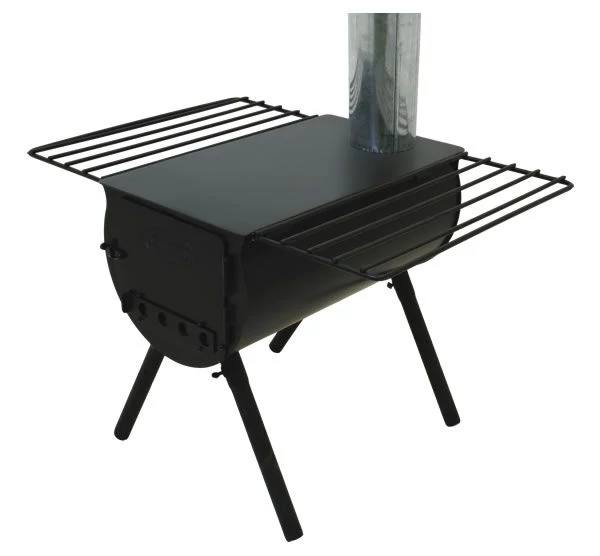
The Alpine Heavy Duty Cylinder System is a different kind of camping stove from the propane burners elsewhere in this library. Camp Chef's US record identifies SKU CS14 / UPC 033246210247; its exact instruction PDF calls the model a 14-by-24-inch Wall Tent Stove. Wood burns in the firebox beneath a continuous flat top. The product page calls that surface a cooking area and describes the door damper as a way to control heat for cooking chores. It also says the system is designed to accept a standard wood-system water heater. That heater is an optional fit, not a package item established by the page.
This is not a conventional one-burner or two-burner appliance. The maker lists no burner count, independent cooking positions or maximum pot diameter. The overall capacity figure of 1.67 cubic feet is storage volume, not cookware capacity, and a photo of a roomy flat top cannot establish that a particular pot fits. The source record also gives no pot-layout diagram. If your meal requires two independently controlled burners or a known large-pan limit, this assessment cannot certify that fit.
The complete stove-and-chimney setup is the decision
Camp Chef says the package contains the internal fire grate, five nested chimney sections, chimney damper, spark arrestor, removable legs and side drying racks. It describes the parts as nesting inside the stove for transport. Listed dimensions with racks are 24 inches deep, 30.5 inches wide and 22.25 inches high; the chimney is listed as 5 inches in diameter and 10 feet long. The published total weight is 74 pounds. Those are system-scale logistics for a vehicle or outfitter setup, not a backpacking option. Plan space for the stove, packed components, firewood and any compatible water heater instead of treating it like a small burner with a pot.
The manual explains that door air intake and a chimney damper affect heat, and advises reducing air to avoid overheating. This supports manual adjustment of a wood fire, not a tested simmer range or the fine knob control of a gas stove. Wood species, moisture, fire size, draft and weather will matter, but this review does not claim to have measured any of them. The manual says dry hardwoods burn more efficiently and notes that softer woods create more creosote; follow its fuel and cleaning guidance rather than assuming steady gas-like output.
Strict tent, ventilation and fire-clearance limits
The exact CS14 manual says tent wood stoves are designed for tents and outdoors only, not cabins or workshops. It gives a recommended tent-size range of 10 by 12 feet minimum to 14 by 16 feet maximum. It requires a suitable rubber-style stove jack rather than passing the pipe through tent fabric, including through a rain fly, and a minimum 20-square-inch open window or door area for ventilation. It also calls for a fireproof surface, at least two feet between the firebox and tent walls, at least three feet from combustible material, and a three-foot nonflammable area around the stove. The pipe should extend at least six inches above the tent ridge.
Those are demanding, model-specific setup conditions, not a general checklist that makes any tent safe. The manual warns that sparks can damage tent roofs; it says to use the supplied spark arrestor, inspect it daily and clean it every two or three days to reduce blockage and chimney-fire risk. It also describes curing the paint before tent use and securing pipe joints in windy conditions. If a suitable tent, stove jack, ventilation opening, fireproof floor and clearances are not all available, do not use this stove in that setup. The product's wall-tent name is not a substitute for reading the complete instructions or checking local fire restrictions.
Why it will not pass several finder filters
The CS14 burns wood, not an MSR 80/20 threaded canister, and the manual does not document a separate windscreen. Its firebox should not be counted as a burner: Camp Chef publishes no burner count, so the matcher leaves the one-burner minimum unknown instead of guessing. It likewise has no published maximum pot diameter and no manufacturer-listed minimum weight. The page's 74-pound total weight is relevant to moving the whole system, but does not become a small bare-stove figure for a grams-based weight filter.
Compared with a Camp Chef gas system such as the PRO 14, the Alpine exchanges independent knobs and a propane connection for firewood, a tent-specific chimney and a broad heated top. It may suit a long vehicle-supported wall-tent camp where those requirements are intentional. It is not the convenient choice for a quick open-air boil, a cabin, an ordinary backpacking tent or a shopper who needs quantified pan clearance. No ownership, field experience, measured output or customer review is represented here.
Check the exact CS14 package and site plan
Verify the CS14 label and the matched 14-by-24-inch manual. Confirm that the expected pipe, damper, spark arrestor, fire grate, legs and racks are present; check how an optional water heater is sold and installed. The product page's 74-pound total and dimensions should be part of transport planning, while the manual's tent size, jack, ventilation and clearance requirements determine whether your site is suitable. Camp Chef's gas-stove recall notice identifies different models and UPCs; that comparison is not a blanket safety guarantee. This assessment contains no current price, availability, rating or firsthand-use claim.
Key specifications
Key details at a glance
| Fuel connector | Wood firebox |
|---|---|
| Specified fuel blend | Firewood |
Use the exact model’s instructions for operating limits, supplied equipment and version differences.
Sources for this review
Sources for this assessment
- Camp Chef official Alpine Heavy Duty Cylinder System product page, exact SKU CS14
- Camp Chef official Shopify product record for CS14 / UPC 033246210247
- Camp Chef exact CS14 manual, 14 by 24 Wall Tent Stove
- Camp Chef official Shop Cooking Systems collection capture; CS14 card
- Camp Chef official recall notice checked for CS14 / UPC 033246210247
Compare this stove against your actual setup
Use the finder for a fact-based shortlist, then confirm the exact manual, fuel cartridge and package before use.